
Auto Like on Instagram: Safe Strategies, Risks & Better Alternatives (2026)
Discover whether auto likes still work in 2026, what risks they carry, safe Meta-approved options, and safer organic strategies for lasting growth.
Mar 13, 2026



Discord's global “teen-by-default” rollout in March 2026 requires selfies or IDs for full access. Explore the changes, privacy concerns from the 2025 breach.
Discord's latest policy shift is making waves: starting in early March 2026, all accounts will default to "teen-by-default" settings, restricting access to adult features until age is verified. This global rollout expands protections from pilots in the UK and Australia, aiming to boost teen safety amid rising regulatory pressures like the EU's Digital Services Act and potential U.S. bills such as KOSA. Verification options include an on-device video selfie for AI-based age estimation or uploading a government ID to a verification vendor (Discord says uploaded IDs will be deleted after verification). It's raised ongoing discussions and strong privacy concerns—particularly after a 2025 third-party breach that exposed thousands of users’ ID images.
Context: Builds on existing mandates in the UK and Australia, now going global to enhance child protection.
Rollout: Phased implementation beginning early March 2026.
Default Mode: All new and existing accounts set to "teen-appropriate" experience, restricting age-gated servers, NSFW channels, Stage voice features, and DMs from non-friends.
Verification Options: Starts with automatic age inference based on non-sensitive signals (e.g., account activity); escalates to on-device video selfie (facial age estimation, not stored); or government ID upload to a third-party vendor (deleted post-verification).
Privacy Risk Context: Follows a 2025 breach at a third-party vendor that exposed ~70,000 users' ID photos, fueling distrust in data handling.
In its safety blog and press release, Discord frames this as a proactive measure to create safer online spaces for minors. The "teen-by-default" approach—already tested in regulated regions—will now apply worldwide, aligning with international laws that demand stricter age checks.
Discord emphasizes minimal disruption: Most adults should pass automatically via an age-inference model using signals like account tenure and behavior patterns (no personal data involved). Only if that's inconclusive will users be prompted for further verification. The company highlights enhancements to existing safety features, like improved content filters and reporting tools, and promises a gradual rollout to ease the transition.
Here are the key steps:
1. Automatic Inference: Discord first analyzes non-sensitive account data (e.g., usage history, tenure) to estimate age. If it confidently identifies you as an adult, you're cleared—no action required. This could cover the majority of users, minimizing hassle.
2. On-Device Video Selfie: If inference isn't conclusive, you'll be prompted for a short video selfie. AI performs facial age estimation directly on your device—Discord claims no data is sent or stored, reducing exposure risks.
3. ID Upload as Fallback: If the selfie option fails or isn't feasible, upload a photo of your government-issued ID to a third-party verification partner. Discord states these are deleted immediately after checks, but past vendor breaches make this the riskiest step.
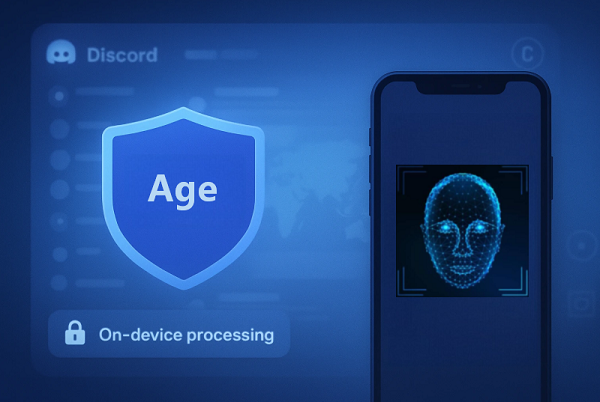
Discord tries to minimize uploads, but some users will still be asked to provide identity documents. For privacy-conscious users, sticking to inference or accepting restrictions might be preferable.
This isn't just a user-level change—it could reshape how Discord communities function.
Casual users might notice immediate limits, like the inability to join mature servers or send DMs to strangers, leading to frustration if they forget to verify.
Server admins in gaming, crypto, or professional groups could see temporary engagement drops, as unverified members won't appear in adult channels.
Developers building bots or integrations (e.g., for content delivery or moderation) will need to update code to handle "teen" restrictions gracefully.
On a global scale, this reflects a trend toward mandatory age gates, similar to rules under the EU's GDPR or the UK's Online Safety Bill. Businesses using Discord for teams or events may face compliance hurdles, especially in regions with strict data laws. Reactions are mixed: Outrage over "surveillance" (e.g., "Discord wants my face? Switching apps") alongside support for child safety.
The announcement has ignited debates online, with users voicing fears of privacy erosion. The core issue? Vendor risks: In late 2025, a third-party incident exposed thousands of Discord users’ ID images, turning a "secure" process into a cautionary tale about outsourcing sensitive data. Even with Discord's assurances—on-device processing for selfies and post-verification deletion for IDs—centralized systems remain vulnerable to hacks, leaks, or misuse. Some users think this could drive users away.
Proxies protect network signals and help admins test flows; they do not replace identity verification.
What proxies can do
Hide/rotate IPs: Mask geolocation and ISP associations during browsing or admin workflows.
Geo-testing: Let admins/devs simulate how Discord behaves from different countries to validate region-specific features or restrictions.
Safer tooling footprint: Route moderation or analytics bots through separate residential IP pools to reduce correlation between operator accounts and automation.
Reduce scraping flags: For public, compliant scraping of non-sensitive endpoints (observe Discord’s TOS), rotating residential IPs lowers the chance of IP blocks.
For example:
What proxies cannot do
They cannot bypass a required selfie or ID. Identity checks are tied to biometric/document data, not IPs.
They don’t make uploads risk-free. A proxy won’t stop a vendor from storing or mishandling an uploaded ID.
Responsible-use note: Do not use proxies to evade platform rules. Read Discord’s Terms of Service before automating or testing account behavior.
For Regular Users: If verification is needed, prefer the on-device selfie to minimize vendor risks. Privacy-first? Accept teen defaults for casual use and use proxies for general anonymous browsing. Backup your account data just in case.
For Server Admins & Community Owners: Update welcome messages, FAQs, and rules with verification timelines and options. Use proxies for geo-tests to ensure your server works globally.
For Developers & Bot Builders: Add fallbacks in code (e.g., banners for restricted users). Test integrations via proxies in target regions—log results for audits. If handling user data, review vendor contracts inspired by the 2025 breach.
Q: Is verification mandatory to use Discord?
A: No—you can stay in teen-restricted mode for basic features; it's only required for adult content and full access.
Q: Will Discord store my selfie or ID forever?
A: Selfies are processed on-device and not stored; IDs are deleted post-verification by vendors. However, the 2025 breach shows risks remain—opt for alternatives if possible.
Q: Can a proxy bypass verification?
A: No, but it can protect your IP during regular use and testing.
Q: What if I'm already verified in the UK/Australia?
A: Existing verifications should carry over seamlessly.
Q: How does this affect costs or performance?
A: Verification is free, but restrictions might slow community growth—plan ahead.
Discord's teen-by-default rollout is a step toward safer spaces, but it underscores the tension between protection and privacy—especially post-2025 breach. By understanding the flow and risks, you can make informed choices. If you manage communities or value anonymity, GoProxy's residential proxies offer ethical tools for geo-testing, IP rotation, and secure workflows. Start with our free trial for Discord-specific setups.
< Previous
Next >


 Cancel anytime No credit card required